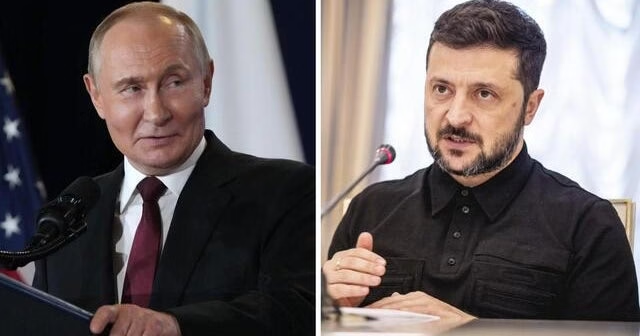
In view of this week’s historic White House meetings, President Volodimier Zelansky says Ukraine and his colleagues “are already working on solid materials of security guarantee”.
The Sir Kire Stmmers are presiding over a virtual meeting of countries that have been designed to help secure Ukraine after a peace deal – the so -called “coalition of alliance”.
And Britain has sent its main defense staff Admiral Sir Tony Redkin to Washington to find out how the US can help. Cogs are clearly changing.
But what does “safety guarantee” actually mean in practice?
There is a detailed spectrum here, ranging ranging from “boots” to the threat of crippling economic restrictions on Russia oil exports.
Let’s begin what Ukraine wants, and not receiving, not at least for the future, and it is NATO membership.
US President Donald Trump has decided that but NATO has a lot of members who quietly oppose it, such as Slovakia, mainly on this basis it will increase the possibility of dragging the possibility of a dramatically transatlantic alliance in a shooting war with Russia.
Apparently Ukraine will require a strong security guarantee after a peace agreement, so that Russia can return and prevent a second, or third, cutting.
This is why Sir Kir and French President Emmanuel Macron have put up the 30-Plus Nation alliance of the interested with the objective of providing Ukraine with some international assurance after the peace deal was signed.
Police is a possible option to police the airspace of Ukraine. This can be done with the base of the aircraft in the current airbase in neighboring Poland or Romania, with American participation.
But they will still require clear and strong rules of engagement if they are more than a symbolic gesture.
In other words, pilots need to know if they can shoot back or not, if Russia said that a Ukrainian city violates the peace deal while firing a cruise missile in the city.
The Black Sea is another region where the Western Security Guarantee can help keep the Russian fleet in the Gulf and ensure the free flow of commercial ships out of the ports such as Odessa.
On the ground, the situation becomes more problematic. Ukraine is a huge country and the front line currently extends over 600 miles or 1000 km-plus.
The coalition of the alliance may not possibly do enough soldiers to deploy to protect the line of contact, even if Russian President Vladimir Putin will agree on what he will not.
Kremlin has reiterated its complete opposition to the presence of any NATO soldiers in Ukraine, which is also under the badge. Therefore, there is a possibility of more in areas of military support training, intelligence and logistic support, which helps Ukraine to reconstruct the army of his injury along with the ongoing supply of weapons and ammunition.
However, a large question mark, Russia will accept the safety guarantee for Ukraine. Many commentators have suggested that Moscow should not say anything in this matter.
But no country in interested alliance is ready to send soldiers to Ukraine. No world war wants to start three.
John Foreman, a former British military attachment in Moscow, which is following every turn and turn of this struggle, told me: “Russia can accept an American security guarantee for Ukraine, which does not do Ukraine and NATO (trops) for Ukraine, in exchange for the formal recognition of the occupied areas.
Many military experts have stated that any future “Assurance Force” provided by the alliance of the alliance should have input from the US, something that Donald Trump refused to commit to the Alaska Summit last week, Donald Trump.
He has now said that America will join, but Ukraine has no shoes on the ground.
In an ideal world, what Ukraine and its allies want from Washington have both American support to the strength of this important future, but also more importantly, a solid undertaking that Russia breaks the peace deal and looks like renewing its attack on Ukraine, then American military muscular-especially will be hand-handed over to return air force.
Trump has indicated that American air support will be available in some form or the other, but given that how many times he has changed his position on how he has ended this war is less than assured.
Lt.gen (Retd) Ben Hodes, who took command of the US Army forces in Europe, says they suspect that “America is really serious about the security guarantee for Ukraine and will distribute more than just words”.
He says: “Europeans do not trust Vladimir Putin and they are not confused about who is aggressive in this war. They are worried that Trump is unable to accept or reluctant that Russia is aggressive. Putin will not follow any agreement until he is forced to do so”.
And here is the underlying contradiction about safety guarantee. How do you make Russia strong to attack Ukraine again, yet it’s not so strong that Russia opposed them and threatens to target Western property if they move forward without Moscow’s consent?
Former British Defense Secretary Sir Ben Walse believes that West, collectively, is not sufficiently firm in standing for Vladimir Putin.
“The reality is that everyone wants to avoid accepting or doing anything that Putin shows no signal of desire to stop murder,” he says.
“As long as Trump or Europe or both Putin are not ready to do something, a little will be achieved.”
Edward Arnold, London -based Thinktank Fellow for European security in Russian, makes conclusions that the alliance of the alliance has been successful in providing a format “that is flexible and may engage in a creative way with Trump supporting Ukraine”.
But he warns: “It remains a political aspiration rather than a rigorous military construction. The next few months will actually test its resolve and political risk hunger”.